
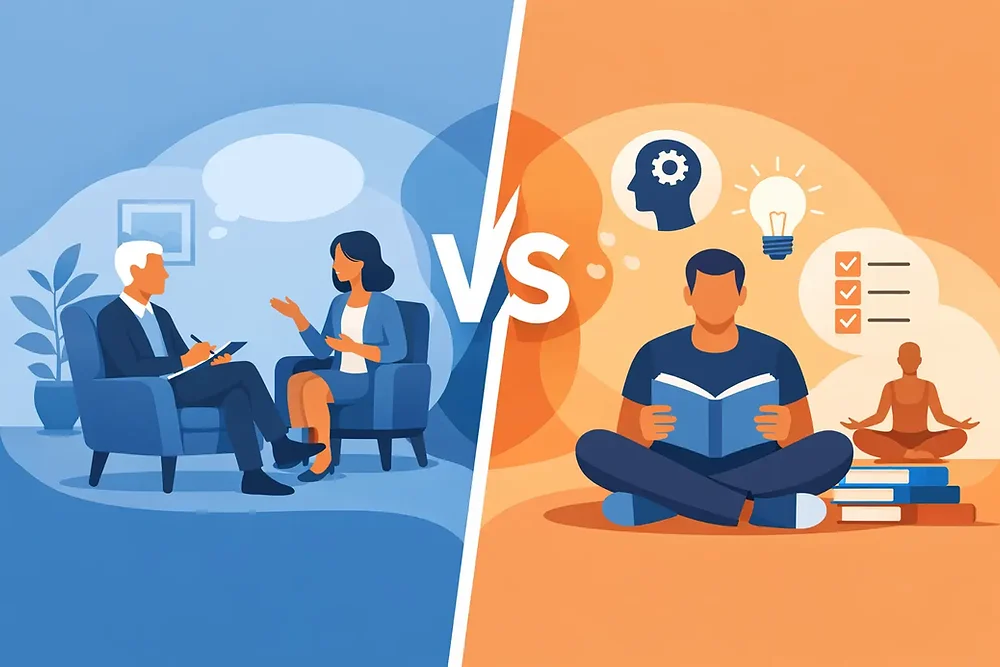
You may have read the books, saved the podcasts, filled a journal, and promised yourself that this time you will finally feel better. Sometimes those tools genuinely help. Sometimes they do not touch the deeper pain underneath. That is where the question of therapy vs self help becomes very real - especially when you are doing your best and still feeling stuck.
This is not a question of which option is morally better, stronger, or more disciplined. It is a question of what kind of support fits your season, your symptoms, and your capacity right now. Self-help can be meaningful. Therapy can be life-changing. In many cases, the healthiest path is not choosing one over the other, but understanding what each can and cannot do.
Therapy vs self help: the core difference
Self-help is usually self-directed. You choose the book, video, workbook, app, or routine, and you apply it on your own. It can give language to what you are feeling, teach practical coping skills, and help you reflect with intention. For people who are motivated, emotionally aware, and dealing with manageable levels of stress, self-help can offer a strong starting point.
Therapy is different because it is relational, personalized, and responsive. You are not just gathering information. You are working with a trained professional who can help you notice patterns, process pain, and move through challenges with support. Therapy is not simply advice. It is a structured space where your inner life is taken seriously and your care is adapted to your needs.
That difference matters. Information can help, but insight often deepens when another person helps you see what you cannot easily see on your own.
Where self-help can be genuinely useful
Self-help is often underestimated by people who assume it is shallow. In reality, good self-help can be practical and grounding. It can help you build routines, understand common emotional patterns, and learn coping strategies for stress, anxiety, low motivation, or relationship conflict.
For someone who is beginning to explore mental health, self-help may feel more accessible. It can be private, affordable, and available right away. You can move at your own pace. You can pause when you need to. For some people, that lower-pressure starting point makes it easier to name what is going on inside.
Self-help can also work well as ongoing support between therapy sessions or after therapy has already helped create a foundation. A guided journal, a breathing practice, or a thoughtful book can reinforce the work you are already doing.
Still, self-help tends to work best when the issue is clear enough to identify and manageable enough to address without professional guidance. It is helpful for growth, reflection, and skill-building. It is less reliable when pain is layered, persistent, or hard to untangle.
Where self-help often falls short
The hardest part of emotional struggle is that your own mind may not be the best place to sort through it alone. When you are anxious, ashamed, grieving, or overwhelmed, it becomes difficult to judge your own patterns accurately. You may minimize what hurts. You may over-blame yourself. You may keep repeating a cycle while believing you are making progress.
This is one of the main limits of self-help. It depends on your ability to assess yourself clearly while you are in distress. That is a heavy ask.
There is also the problem of volume. There are endless resources telling you to heal your attachment style, regulate your nervous system, set better boundaries, think more positively, rest more, work harder, and become your best self. Even useful advice can become overwhelming when it arrives without context. Instead of feeling supported, you may feel like you are failing at healing.
Self-help also cannot respond to you in real time. A book cannot notice when you shut down while talking about your childhood. A podcast cannot gently challenge the story you keep telling yourself. An app cannot build trust with you over time. These relational pieces are often where meaningful healing begins.
What therapy offers that self-help cannot
Therapy provides more than techniques. It offers attuned support. That means someone is listening not only to your words, but to your patterns, your emotional responses, and the places where you feel lost, guarded, or weary.
A skilled therapist can help you make sense of experiences that feel confusing on your own. They can help connect present struggles with past wounds, identify blind spots, and offer practical tools in a way that actually fits your life. That personalized care matters because two people can have the same symptom and need very different support.
Therapy also creates accountability with compassion. Many people know what they should do in theory. The challenge is doing it while exhausted, discouraged, or emotionally flooded. Therapy gives structure to the process. You do not have to carry the full weight of change by yourself.
There is another difference that often goes unspoken. Therapy gives you a safe place to be fully honest. You do not have to perform insight. You do not have to package your pain into something inspirational. You can bring the messy, unfinished version of what you are living through and be met with care.
When therapy is the better choice
If your distress is affecting your daily life, relationships, work, sleep, or sense of safety, therapy is worth serious consideration. The same is true if you feel stuck in repeated patterns, if your emotions feel bigger than your coping skills, or if you have tried self-help and still feel no lasting shift.
Therapy is especially important when you are dealing with trauma, panic, depression, grief that feels immobilizing, self-harm, or thoughts of hopelessness. In those moments, support should not rest on willpower alone.
Sometimes the sign is quieter. You may be functioning well on the outside but carrying chronic tension, resentment, emptiness, or disconnection on the inside. You may be the person others rely on, while you quietly unravel in private. Therapy can help before a crisis arrives. You do not have to wait until everything falls apart to deserve care.
Therapy vs self help is not always either-or
Many people benefit most from both. Therapy can provide the relationship, insight, and guidance. Self-help can provide repetition, reflection, and day-to-day reinforcement. Together, they can support both healing and growth.
For example, a therapist may help you understand why boundary-setting feels so frightening, while a workbook helps you practice boundary language between sessions. Therapy may help you process grief, while a journal helps you notice how that grief moves through your week. One offers personalized support. The other can help you stay engaged with the work.
The key is knowing which tool should lead. If you are stable and looking to grow, self-help may be enough for now. If you are overwhelmed, confused, or emotionally burdened in ways that keep repeating, therapy should not be treated as a last resort.
How to decide what you need right now
A gentle place to begin is with honesty. Ask yourself whether you need more information or more support. If you already know the coping skills but struggle to use them, support may matter more than another resource. If your pain feels tangled, old, or difficult to name, therapy may offer the clarity that self-help cannot.
It can also help to notice how you feel after using self-help resources. Do you feel calmer, clearer, and more capable? Or do you feel briefly inspired and then more discouraged because nothing really changes? That response tells you something.
If cost or access has kept therapy feeling out of reach, that concern is real. Self-help can still be a meaningful bridge, not a failure. But if therapy is available to you, it is okay to choose care that is personal, structured, and compassionate. You are not giving up on yourself by asking for help. You are responding wisely to what your heart and mind may need.
At Charis Counselling, this is how we understand support: not as pressure to fix yourself perfectly, but as an invitation to heal with kindness, honesty, and grace.
If you are weighing therapy vs self help, try letting the question become less about proving your independence and more about honoring your needs. The right support is the support that helps you move toward steadiness, peace, and a fuller sense of yourself.